ROOST / COMPUTE
Give every workload a home.
Launch workloads, follow their console and control their lifecycle. Native Mac builds run Ubuntu; the Linux development provider runs VMs, LXC and Docker.
VM + container lifecycle
BATCAVE / BACKED BY STARK FIBER ENTERPRISE
Build your cloud. Command your compute.
An open infrastructure platform for virtual machines, containers, storage and networks.
Built with RF², our own programming language.
Backed by Stark Fiber Enterprise. In active development.
01 / MEET THE PLATFORM
From the guest console to the recovery point, Batcave is being built to put your infrastructure in your hands. Original RF² execution technology meets VM and container lifecycle tools, with one direction: a complete, open cloud operating platform.
ROOST / COMPUTE
Launch workloads, follow their console and control their lifecycle. Native Mac builds run Ubuntu; the Linux development provider runs VMs, LXC and Docker.
VM + container lifecycleVAULT / STORAGE
Give workloads persistent disks and recover earlier generations. Backup, restore and incremental retention have dedicated tests; shared SAN and distributed storage are the next horizon.
Persistence + recoveryWINGS / NETWORK
VM NAT today. Tenant networks, policy and cross-host connectivity next, with explicit isolation and recovery checks.
NAT tested · fabric plannedECHO / OBSERVABILITY
See guest health and trace what actually ran. Echo Link will extend that visibility through a persistent health channel, with latency and failure detection measured against a declared baseline.
Health tested · Echo Link planned02 / REAL BUILDS, REAL SCREENS
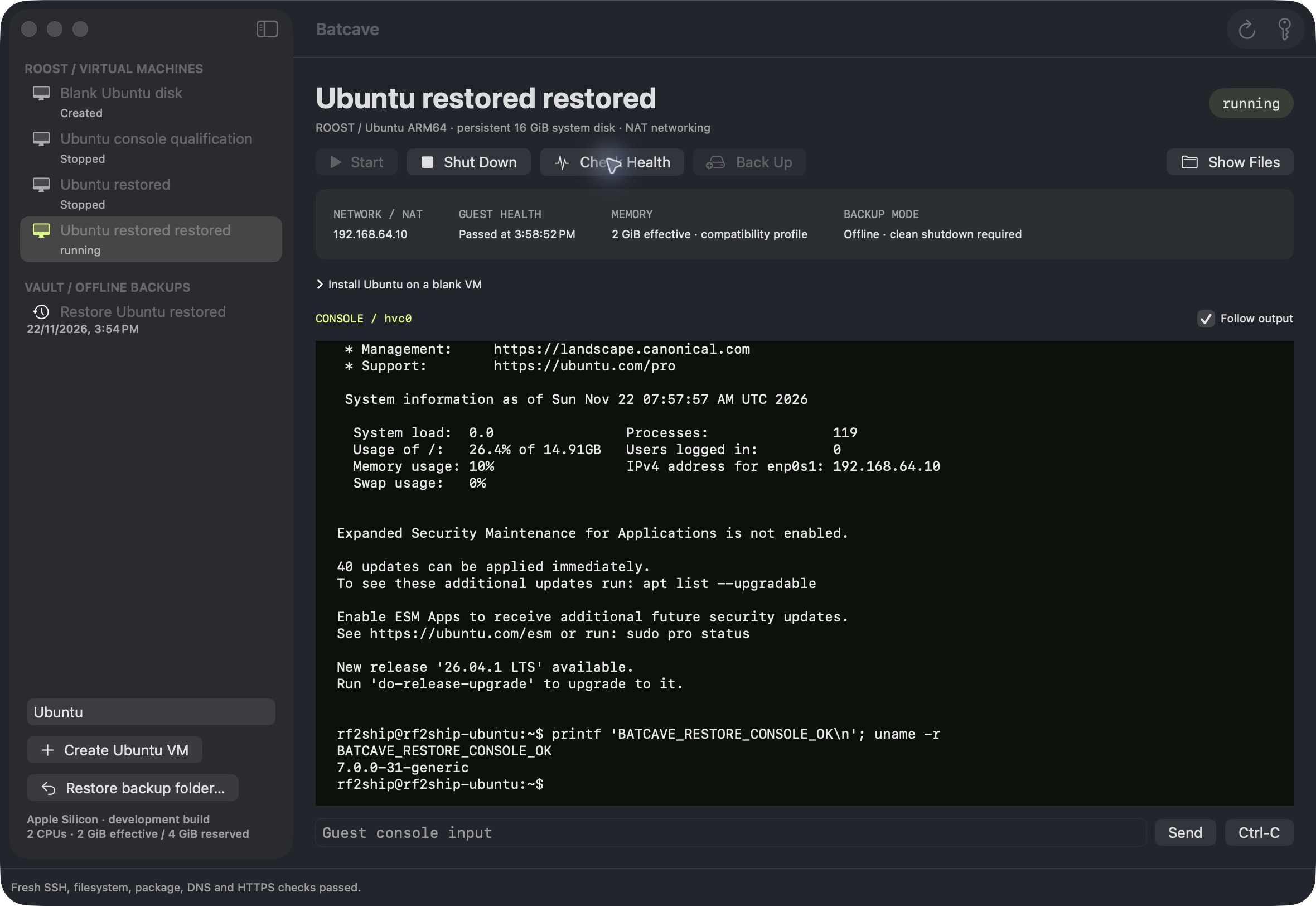
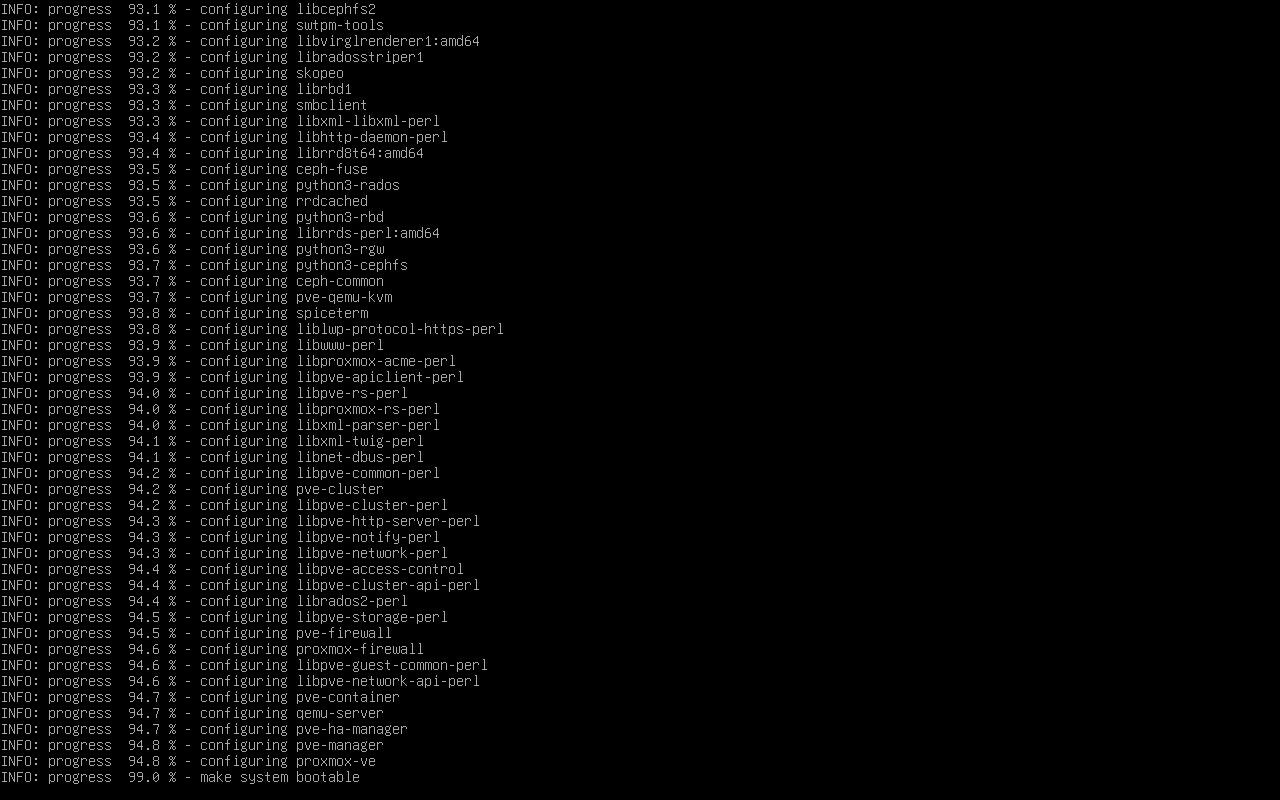
Ubuntu in the native Mac console. Proxmox in the Linux lab. These are actual running builds, captured during lifecycle and recovery testing.
03 / WHY RF²?
RF² is our own programming language, developed at Stark Fiber Enterprise. Batcave uses it to build original emulation, resource admission and native execution technology—so we can shape the behavior, inspect the machine code and evolve the platform at its foundations.
The latest foundation emits a standalone Linux/x86 monitor that boots a fixed Linux kernel to its initial userspace process through KVM, without QEMU or a language runtime in that path. Linux/KVM supplies virtualization. This is a purpose-built emitter, not yet a general RF² Linux compiler.
Read the native RF² source ↗Explicit guest memory, register and I/O contracts.
A small, standalone Linux/x86 executable.
Linux KVM and the CPU run the guest.
Output checks, faults, cleanup and matched measurements.
Independent engineering, explicit platform boundaries: RF² generates native machine code. The current Linux monitor uses KVM; a Linux-independent Batcave host is a future backend, requiring its own boot, drivers, memory management and device stack.
04 / CHOOSE YOUR FLIGHT PATH
Start with the development paths available today. Follow the next milestones toward desktop hosts, dedicated machines and a bootable Batcave cloud platform.
Apple Silicon VM console, restored Ubuntu and selected health/recovery evidence. Installer repeatability and release packaging remain open.
Local developmentVM/LXC/Docker provider experiments and a separate native RF² KVM monitor for raw-code guests and an experimental Linux kernel/PID1 boot. Persistent native disks, interactive console and networking are next.
Tested lab profilesHost backend, desktop experience and installation need implementation and their own compatibility tests.
PlannedAn installable infrastructure layer with boot, drivers, management, upgrades and recovery. There is no qualified Batcave host ISO to download yet.
PlannedUbuntu and Proxmox have specific provider/lab evidence. The native KVM path accepts small raw x86 programs and a prepared fixed Linux kernel/RAM-root profile, not an OS ISO. Windows/macOS guests, Android APKs, iOS apps and creative-app compatibility require separate backends, licences, runtime adapters and tests. They are not supported today. HCI clustering, SAN, HA, DC/DRC and blockchain workload profiles remain open. The tested portfolio does not establish 100 simultaneous VMs, LXCs or Docker containers.
05 / PERFORMANCE YOU CAN INSPECT
Explore the measured execution costs of our native monitor alongside C and QEMU. Every workload is included, with the samples and method available to inspect.
Lower is better. Median elapsed time including process launch, setup, execution and teardown. 11 shuffled trials per cell, 23 November 2026.
| Workload | RF² / KVM | C / KVM | QEMU / KVM | QEMU / TCG |
|---|---|---|---|---|
| Short arithmetic | 47.778 | 51.766 | 103.865 | 30.957 |
| 1M arithmetic | 45.662 | 36.581 | 114.697 | 41.292 |
| 10M arithmetic | 55.875 | 43.519 | 123.716 | 60.385 |
| 1M memory | 39.980 | 38.612 | 110.762 | 40.869 |
One shared nested Linux/x86 lab; a validated warm-up precedes each cell. Native monitors use 2 MiB guest RAM and a narrow I/O/halt contract. QEMU 7.2.22 models a broader PC, uses a reset ROM and loader-file input, and exits through a debug device. C uses GCC 12.2.0 -O3 and its normal runtime. Machine scope, input and termination differ. These are raw-code fixtures, not Ubuntu/Proxmox performance, steady-state CPU speed, energy or a universal acceleration result.
Download samples, order and source identity ↗06 / BUILD IN THE OPEN
Original Batcave code is MIT-licensed. Explore RF² on GitHub, inspect the new native monitor source, report problems and help shape the next execution backend.
MIT licence · Third-party kernels, engines and operating systems retain their own licences. Public installers and enterprise support plans are not available yet.